Everything, from flowers to planets, is built from a few kinds of particle.
Four forces push and pull them: gravity, electromagnetism, the strong force and the weak force. Physics has joined three of them in one theory. A theory of everything would bring in the fourth.
AI-generated image, not a photograph of a real person or place.
A few building blocks
Four forces
One missing link
Simple rules, everything follows
THE SHORT ANSWER
Three joined up, one still out.
The Standard Model unites the building blocks of matter and three of the four forces. Gravity is the odd one out.
FORCES
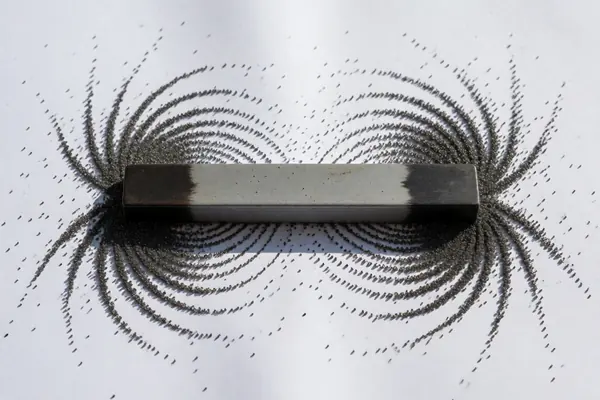
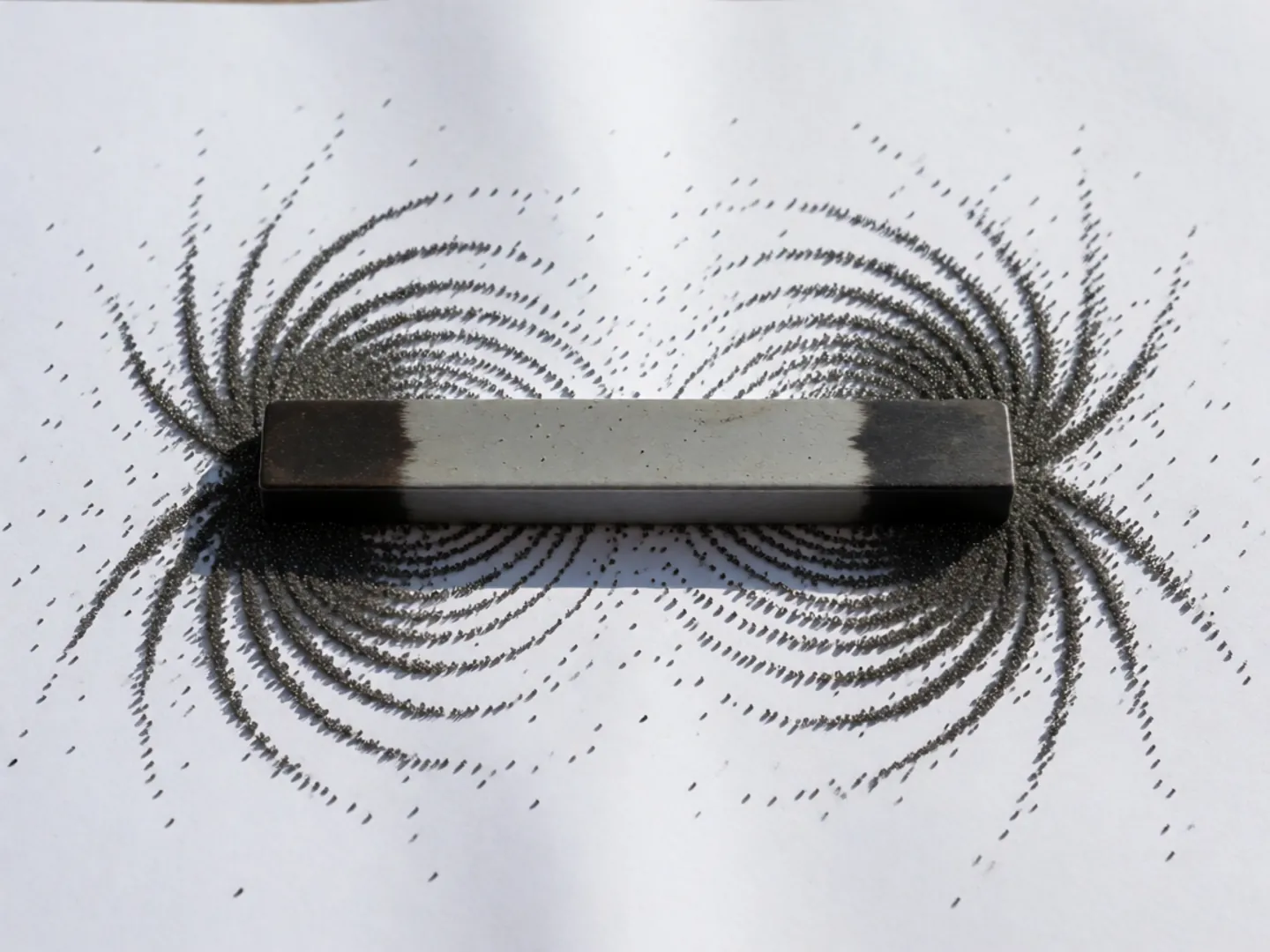
Electricity meets magnetism
In the 1800s, electricity and magnetism turned out to be two sides of one force. In the 1960s physicists joined electromagnetism to the weak force too.
Pick a force to see what it does. The bar shows how far it reaches: gravity and electromagnetism act across great distances, the nuclear forces only inside atoms.
Based on Nobel Prize press materials for the 1979 and 2013 physics prizes.
TWO NUMBERS WORTH KNOWING
Most of it explained, not all.
One figure for what the Standard Model covers, one for what it leaves out.
3 of 4
Forces the Standard Model unites
The Standard Model unites the fundamental building blocks of nature with electromagnetism, the weak force and the strong force. Gravitation remains outside the model.
FORCES · NOBELPRIZE.ORG
≈ 1/5
Share of matter the model describes
The model describes only visible matter, which accounts for about one fifth of all matter. The rest is dark matter of an unknown kind, seen only through its gravity.
MATTER · NOBELPRIZE.ORG
The Standard Model also treats neutrinos as virtually massless, while experiments show they do have mass: another sign it is not the final theory.
FOUR STEPS TOWARDS ONE THEORY
How physics keeps joining things up.
Physics aims to find common causes for things that look unrelated. Each step below joined two ideas into one.
Apples and moons
Newton's gravity explained both a falling apple and the Moon going round the Earth.
Electricity and magnetism
Work by Oersted, Faraday and Maxwell in the 1800s showed they are one force, and that light is an electromagnetic wave.
Electromagnetism and the weak force
A theory from the 1960s unified the two, honoured with the 1979 Nobel Prize after experiments at CERN in 1973 backed it.
A field that gives mass
The Higgs field, proposed in 1964 and confirmed in 2012, explained how particles get their mass and completed the Standard Model.
AI-generated image, not a photograph of a real person or place.AI-generated image, not a photograph of a real person or place.
THE MISSING PIECE
Where gravity doesn't fit.
In the Standard Model, space is filled with invisible fields, and particles are small packages of vibration in those fields. Three forces fit this picture. Gravity, the most familiar force of all, does not yet.
A theory of everything would describe all four forces in one framework. The UK, one of CERN's 12 founding members in 1954, has around 1,000 scientists, researchers and technologists based there, still looking for what lies beyond.
Questions
Questions people ask
What is a theory of everything?
It is the idea of a single theory describing all four fundamental forces. Today's Standard Model unites three of them, electromagnetism and the weak and strong forces, but leaves out gravity.
What are the four fundamental forces?
Gravitation, electromagnetism, the weak force and the strong force. Gravity and electromagnetism act over long distances; the strong and weak forces only at about the scale of an atomic nucleus or less.
What does the Higgs particle do?
It comes from an invisible field that fills all space. Particles gain mass through contact with that field; without it, electrons and quarks would be massless and could not form atoms.
When was the Higgs particle discovered?
It was announced at CERN on 4 July 2012, confirming a theory proposed in 1964. The theory was awarded the 2013 Nobel Prize in Physics.
Is the UK part of CERN?
Yes. UKRI says the UK is one of 12 founding members of CERN, which was founded in 1954, and around 1,000 UK scientists, researchers and technologists are based there.